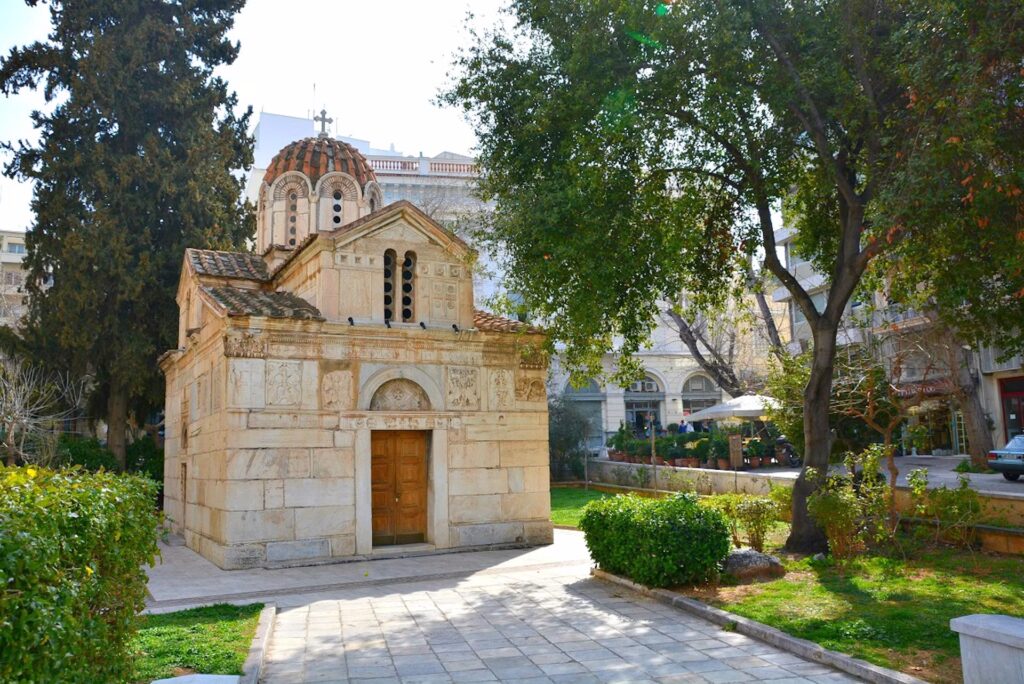
Agios Eleftherios was constructed around the turn of the thirteenth century, though the exact date remains subject to historical debate. Most scholars attribute its construction to Archbishop Michael Acominatus Choniates, who served from 1180 to 1204 and was known for his exceptional education in classical Greek culture and history. Choniates was not a monk who rejected pagan learning but rather a sophisticated intellectual who admired and sought to preserve the aesthetic and mythological heritage of ancient Athens.
This appreciation for classical culture is evident throughout the church’s design. Unlike other Byzantine churches that attempted to distance themselves from pagan forms, Agios Eleftherios deliberately incorporates classical architectural and decorative elements into its structure. The walls are built almost entirely of recycled marble blocks and decorative stones salvaged from ancient temples, classical monuments, and Roman buildings across Athens. The exterior facade is wrapped with a frieze of ninety sculptural panels that deliberately resemble the carved reliefs of an ancient Greek temple, yet these same panels are marked with carved Christian crosses, creating a visual statement that Christianity does not reject but rather fulfills and transforms the classical tradition.
The church is dedicated to Saint Eleftherios, the protector of pregnant women and infants in Orthodox Christian tradition, continuing the sacred function of the ancient site. The church was built directly on the ruins of a much earlier temple dedicated to Eileithyia, the ancient Greek goddess of childbirth and midwifery, creating a continuity of sacred purpose that spans the entire history of Western civilization from antiquity to the present day.
The church follows the typical Byzantine cross-in-square architectural layout topped by an octagonal Athenian Dome, yet the use of marble in construction rather than the typical brick masonry system of Byzantine churches makes it architecturally distinctive. The combination of classical sculptural decoration with Byzantine architectural form creates a unique aesthetic that no other church in Athens replicates.
The church survived centuries of turbulence including Ottoman occupation and numerous military conflicts. According to local tradition, during the Turkish occupation in 1648, a Turkish commander attempted to destroy the church with a cannon, but a miraculous event saved it—the cannonball supposedly bounced off without destroying the building. While this account may be more legend than historical fact, it speaks to the enduring cultural significance of this small church to the Athenian population.
The church underwent a complete restoration in 1856 that brought it back to its original appearance, and it remains a fully functional place of worship to this day. It is often called the “Little Metropolis” or “Mikri Metropoli” to distinguish it from the grand Metropolitan Cathedral that now dominates the same square.