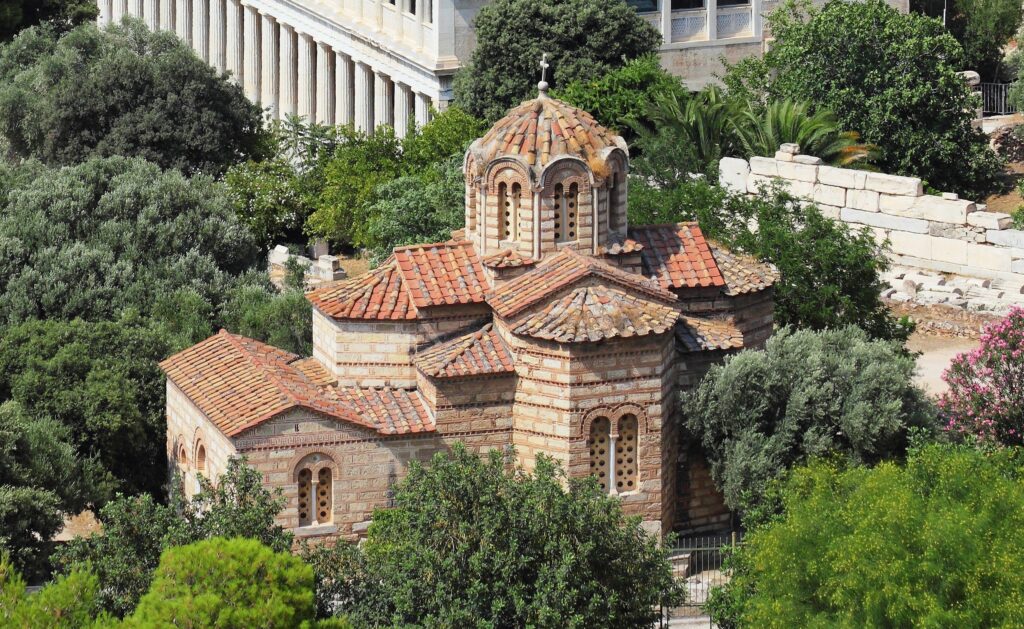
The Church of the Holy Apostles occupies an extraordinarily striking position within the Ancient Agora, positioned on the western edge of the archaeological site surrounded by the ruins of classical temples and civic buildings. The contrast between the small, intimate medieval church and the vast sweep of ancient Greek monuments creates one of the most visually and intellectually compelling experiences available at any single site in central Athens.
The church was built in the tenth century, a period of relative stability and flourishing in the Byzantine Empire known as the Macedonian Renaissance. It represents the architectural style of middle Byzantine church design, with a cross-in-square plan and a distinctive dome characteristic of the period. The church measures approximately 8 meters long by 8 meters wide, making it remarkably compact even in comparison to other Byzantine churches in Athens.
The church features the distinctive red-tiled eight-sided dome known as the Athenian Dome, an architectural signature that marks these churches as specifically Athenian products of the Byzantine period. This dome form, found on countless churches throughout medieval Athens, has become one of the most recognizable features of the city’s Byzantine architectural heritage.
The church retains much of its original decoration, including well-preserved frescoes that have survived centuries of exposure and the various transformations the building has undergone. The quality and condition of these frescoes make the Church of the Holy Apostles one of the finest surviving examples of tenth-century Byzantine fresco painting anywhere in Greece.
The church’s position within the Agora is not accidental. The site has sacred significance stretching back to ancient times, and the placement of the medieval Christian church on this ancient soil represents the continuity of sacred function that characterizes so many Orthodox churches in Greece. The church was likely built deliberately on or near an earlier sacred site, just as so many other Byzantine churches were constructed on the foundations of classical temples.
Today, the church sits almost alone in the green landscape of the Agora, a quiet and contemplative space that many visitors to the more famous Ancient Agora site overlook entirely. It is an easy walk from the Stoa of Attalos and the Temple of Hephaestus, yet feels worlds away from those busier, more visited monuments.