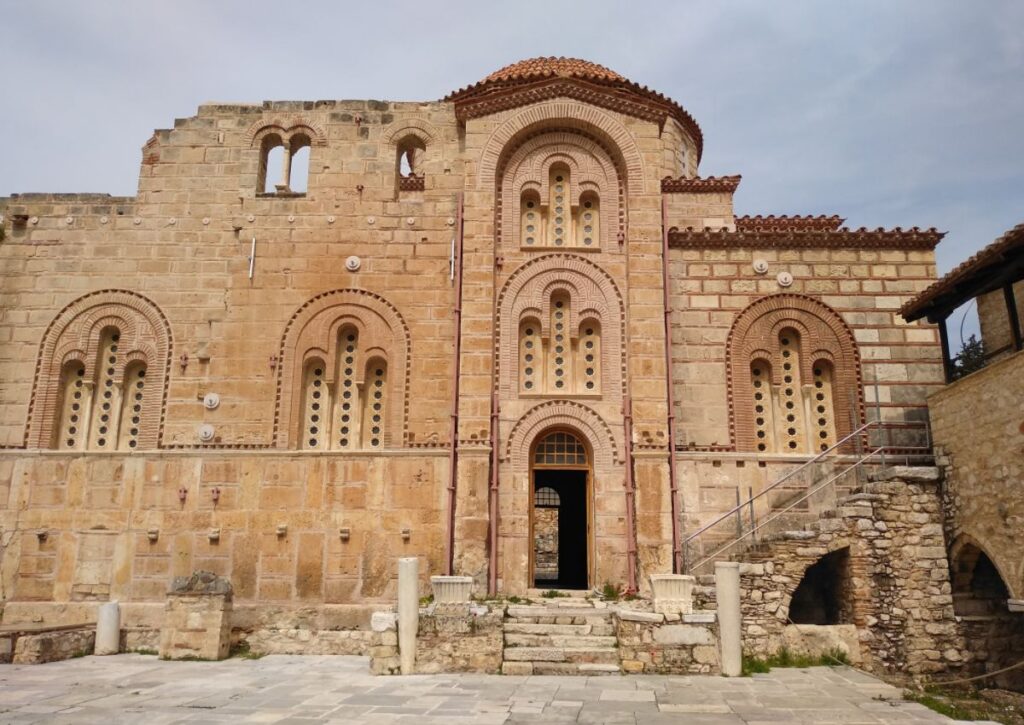
The Daphni Monastery was originally built in the sixth century AD on the site of an ancient sanctuary dedicated to Apollo Daphnaeus, the god of light and prophecy. The original structure was enclosed by strong defensive walls in a nearly square fortification pattern, typical of early Byzantine monastery design. The sanctuary was destroyed during the Goth invasion in 398 AD, a loss that marked the end of the pagan religious tradition at this site.
The monastery was rebuilt and expanded over the following centuries, but the surviving structures that visitors see today all date from the eleventh century, the golden age of middle Byzantine architecture and art. In 1100 AD, the monastery was reconstructed under the patronage of Byzantine emperors of the Komnenos dynasty, creating an octagonal cruciform church topped with a dome, a design of remarkable architectural sophistication and grace.
The monastery survived the Crusader sack of 1205, when the Crusaders looted the site and destroyed much of its artistic treasures. The Crusaders remained in control of Athens and the surrounding region, occupying the monastery and later reconstructing parts of it. French Catholic monks eventually took over the monastery, adding the exonarthex (outer entrance portico) and building an enclosure around the complex. They remained until 1456, when the Ottoman conquest of Athens expelled them.
Under Ottoman rule, from 1458 onward, Orthodox monks returned to the monastery and built new two-story structures with cells, dining halls, storerooms, and perimeter galleries within the monastic enclosure. The monastery continued to function as an active religious community for centuries until 1821, when it was used as a military garrison during the Greek War of Independence. By the end of the nineteenth century it had been designated an archaeological site, beginning a long process of scholarly study and careful restoration.
Unfortunately, the catastrophic 1999 earthquake caused severe damage to the monastery, destroying much of the superstructure and requiring extensive restoration work. The restoration was completed in recent years, allowing visitors once again to step inside and experience the mosaics that make Daphni one of the greatest artistic achievements of the medieval world.