Book Athens Transfers to Hadrian's Library and Hadrian's Arch

Book Athens Transfers to Hadrian's Library and Hadrian's Arch

Traveling from Athens International Airport to Hadrian’s Library and Hadrian’s Arch is a journey into the Roman chapter of Athens’ story, and organizing your athens transfer in advance is the most straightforward way to begin. Both monuments were built in 131 and 132 AD by the Emperor Hadrian during his third visit to a city he loved above all others in his vast empire. Together they represent the most tangible evidence of how deeply and permanently Rome shaped the Athens we see today.

Book Athens Transfers to Hadrian's Library and Hadrian's Arch

Distance and Travel Time from Athens Airport to Hadrian's Library and Hadrian's Arch

Athens International Airport Eleftherios Venizelos is approximately 35 kilometers from the central Athens area where both monuments are located, and the journey typically takes between 35 and 55 minutes depending on traffic and the time of day.

Hadrian’s Library sits adjacent to Monastiraki Square, one of the busiest intersections in central Athens. Hadrian’s Arch stands at the junction of Amalias Avenue and Dionysiou Areopagitou, at the edge of Plaka near the Temple of Olympian Zeus. Both are easily walkable from each other once you are in the city, but arriving in this part of Athens for the first time after a long flight requires knowing where you are going before you get there.

Book Athens Transfers takes all of that out of the picture before you land. A professional driver handles the route, the timing, and the logistics from the airport directly to the area, getting you there efficiently while you focus on the visit ahead.

An Emperor Who Loved Athens More Than Rome

To understand Hadrian’s Library and Hadrian’s Arch, it helps to understand Hadrian himself. Born in 76 AD in what is now Spain, he rose through the Roman military and political ranks to become emperor in 117 AD, ruling until his death in 138 AD.

Of all the places he visited during his reign, Athens held a particular place in his affections. He visited the city at least three times, studied Greek philosophy there, was initiated into the Eleusinian Mysteries, and was eventually granted Athenian citizenship, an extraordinary honor for a Roman emperor.

Each visit left a permanent mark on the city. He completed the Temple of Olympian Zeus, a project begun more than six centuries before his time. He built an arch to mark the boundary between the old Greek city and his new Roman expansion. And he gave Athens a library, the largest and most culturally ambitious building he constructed anywhere in his empire.

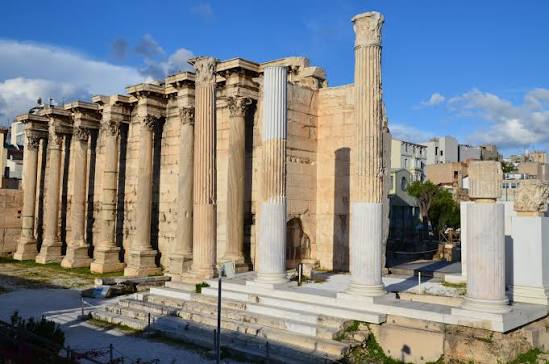
Hadrian’s Library, built in 131 and 132 AD, was not simply a repository for books. It was a full cultural complex, a rectangular peristyle structure measuring approximately 122 by 82 meters, with a single grand entrance on its western side and an enormous interior courtyard surrounded by 100 marble columns.

At its center sat a long ornamental pool, and along the eastern and northern sides were reading halls, lecture rooms, music halls, and exhibition spaces. The library proper housed papyrus scrolls and manuscripts stored in wooden cupboards set into niches in the walls, with an estimated collection of more than 17,000 scrolls at its height.

The western facade facing Areos Street near Monastiraki Square gives the best surviving sense of the building’s original grandeur. Seven of the original fourteen towering Corinthian columns of Karystian marble still stand to their full height, and the four columns of the central gateway were made of rare Phrygian marble imported from what is now Turkey, a deliberate display of Roman wealth and reach.

The library was severely damaged during the Herulian invasion of 267 AD but was subsequently rebuilt, serving different functions across different eras with remarkable resilience. During the Byzantine period it became a church dedicated to the Archangel Michael. During the Ottoman period it served as a mosque, a fortress, the residence of the Turkish governor of Athens, and eventually as an army barracks and a prison.

The building was rediscovered by archaeologists in 1885 and has been under ongoing excavation and study ever since, with later structures gradually cleared to reveal the Roman foundations beneath.

Hadrian’s Arch stands at the edge of Plaka at the junction of Amalias Avenue and Dionysiou Areopagitou, within sight of both the Temple of Olympian Zeus and the Acropolis. Standing approximately 18 meters high and built from Pentelic marble, it is in remarkably fine condition and remains one of the most photographed structures in the entire city.

The arch marked the formal boundary between the ancient Greek city and the new Roman quarter Hadrian had built to its east. Two inscriptions carved on opposite sides made this division explicit. The side facing the Acropolis reads that this is Athens, the ancient city of Theseus. The side facing the new city reads that this is the city of Hadrian and not of Theseus.

Together, the two inscriptions capture something essential about the relationship between Greek heritage and Roman ambition that defined Athens throughout the imperial period.

Private Transfer from Athens Airport to Hadrian's Library and Hadrian's Arch

A private transfer with Book Athens Transfers is the most dependable and comfortable way to travel from Athens Airport to the area around Hadrian’s Library and Hadrian’s Arch. From the moment you walk through arrivals, your driver will be there with your name on a sign, ready to take your luggage and escort you to the vehicle without any waiting or confusion.

Real-time flight monitoring is built into every pre-booked private athens transfer with Book Athens Transfers. Whether your flight lands on schedule, early, or delayed, your driver has already adjusted the pickup accordingly. You never have to manage anything from your end, the process adapts automatically from the moment your flight status changes.

The service is entirely door-to-door, taking you from the airport terminal to the Monastiraki area or directly to Amalias Avenue, with no shared stops or unnecessary detours. Fixed pricing confirmed at booking means the full cost is clear before you travel, with nothing to negotiate or recalculate on arrival.

Premium Transfer for a Day of Roman Athens

Hadrian’s Library and Hadrian’s Arch draw a thoughtful and historically curious kind of visitor, someone who wants to see not just the most famous monuments but the full story of how Athens became the city it is today. A premium transfer from Book Athens Transfers is a natural fit for that kind of purposeful visit.

Premium vehicles include executive sedans or high-end cars offering a quiet, refined, and thoroughly comfortable journey from the airport through to the heart of the ancient city. A premium athens transfer suits historians, classicists, architecture enthusiasts, and culturally motivated travelers, as well as any guest who simply prefers the quality of an executive vehicle after a long or overnight flight.

Booking a premium transfer in advance with Book Athens Transfers is also the most reliable way to secure your preferred vehicle, particularly during the busy spring and summer months when demand for quality transfers across Athens builds consistently.

Athens Airport Minivan for Groups and Touring Parties

Hadrian’s Library and Hadrian’s Arch are regular stops on guided historical tours of Athens, and for larger groups arriving from the airport together, an Athens Airport Minivan from Book Athens Transfers is the most practical and cost-effective solution.

Minivans offer generous seating and plenty of luggage space, keeping the entire group in one vehicle from the arrivals terminal to the Monastiraki area without the need for separate bookings or split arrivals. For organized tour groups where everyone needs to arrive together and on schedule, a minivan from Book Athens Transfers removes the coordination difficulty entirely.

When booking your athens transfer, simply provide your passenger numbers and luggage details, and the right vehicle will be confirmed and ready when you land.

Two Monuments, One Organized Arrival

Taxis from Athens International Airport operate on fixed fares and are available around the clock, but for a day structured around specific historical sites and a planned itinerary, the unpredictability of a rank taxi is an unnecessary risk at the very start.

Queue times during busy arrival periods can be significant, and there is no flight monitoring, no assigned driver, and no guarantee on vehicle quality or punctuality. Hadrian’s Library and Hadrian’s Arch are best explored as part of a broader morning in the historic center, paired naturally with the nearby Roman Agora, the Ancient Agora, and the Temple of Olympian Zeus, all within easy walking distance of each other. Making the most of that kind of itinerary requires arriving with time and energy intact.

Two Monuments, One Organized Arrival

Booking your athens transfer with Book Athens Transfers puts a professional, experienced driver in charge of the full journey from the airport to the historic center. With solid knowledge of the Monastiraki area, Amalias Avenue, and the most efficient routes into central Athens, your driver will have you there smoothly and on time, whatever hour your flight arrives.

Hadrian’s Arch is freely visible from the street and can be admired without a ticket at any hour. Hadrian’s Library requires a separate entry ticket, or admission is included in the combined five-day ticket covering multiple major sites across central Athens. Allow thirty to sixty minutes at the library site, and combine it with a ten-minute walk southeast along Amalias Avenue to the arch.

Whether you choose a standard private vehicle, a premium transfer, or an Athens Airport Minivan, organizing your ride with Book Athens Transfers means you arrive in Athens ready to follow in the footsteps of one of the ancient world’s most remarkable emperors.

Share this post