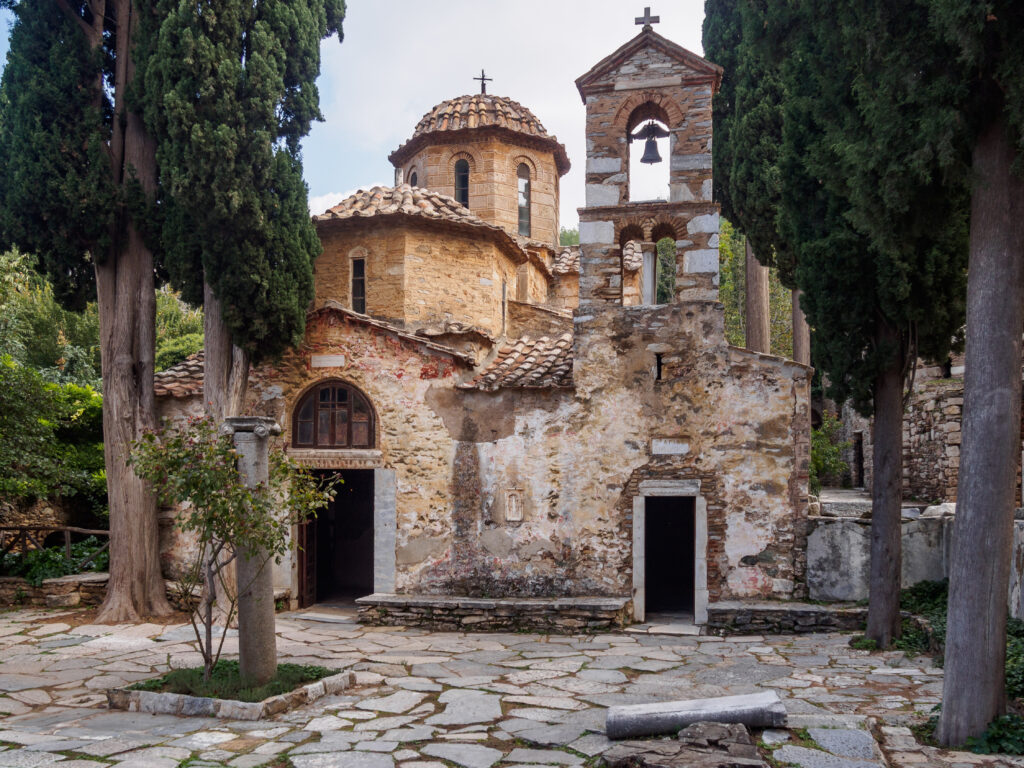
The Kaisariani Monastery was founded in the late eleventh century, around the year 1100, by a figure named Caesarius, from whom both the monastery and the surrounding district took their name. The monastery was constructed deliberately on the ruins of an ancient Roman sanctuary, itself built over an earlier pagan temple dedicated to Aphrodite and Demeter, creating a continuity of sacred purpose that stretches back more than two thousand years.
The main church, or katholikon, was built at the end of the eleventh century in the cross-in-square architectural style characteristic of middle Byzantine church design. The narthex and a chapel dedicated to Saint Anthony were added during the Ottoman period, expanding the monastic complex to accommodate the needs of a thriving monastic community. The church retains much of its original architectural character and continues to serve its sacred purpose.
The monastery’s most distinctive feature is its setting. Surrounded by natural springs, including an ancient fountain with a distinctive ram’s head spout, the monastery occupies a landscape so verdant and peaceful that it feels genuinely removed from the modern city lying in the plain below. The natural springs were believed in antiquity to have therapeutic properties for female fertility, and they continue to flow clear and cold from the mountainside to this day.
During the Byzantine period, Kaisariani was not just a retreat for monks seeking solitude but a significant center of intellectual and spiritual learning. The monastery housed a library rich with manuscripts and theological works, and it attracted some of the most distinguished Byzantine scholars of the era, including the philosopher and theologian Gemistus Plethon. The monastery was frequently visited by Byzantine emperors, Ottoman sultans, and Athenian metropolitans, a testament to its significance and prestige.
The monastery survived the Crusader conquest of Athens in 1205 and continued to flourish under Ottoman rule after 1456. During the Ottoman occupation, it was granted special tax-exempt status, a remarkable privilege that reflected the respect the Ottoman authorities held for the monastery and its monks. This unusual freedom allowed Kaisariani to function as a sanctuary for intellectual monks and to develop into one of the most important centers of learning and cultural preservation in Ottoman-dominated Greece.
The frescoes inside the church, while originally painted in the eleventh and twelfth centuries, were largely replaced with new works in the seventeenth and eighteenth centuries. The surviving interior paintings follow the hagiographic traditions of Mount Athos and Cretan painting, combining the devotional intensity of monastic art with the artistic sophistication of post-Byzantine aesthetics.