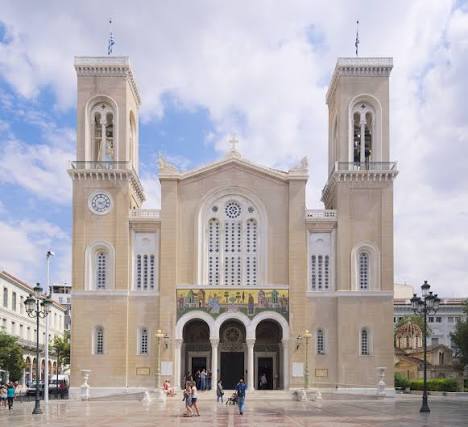
The Metropolitan Cathedral was not built quickly. Construction began on Christmas Day 1842 with a cornerstone ceremony attended by King Otto and Queen Amalia, but work was halted in 1843 due to lack of funds. The project resumed in 1846 and continued intermittently for sixteen more years until the cathedral was finally dedicated on May 21, 1862.
The long construction period reflected not just financial challenges but also the complicated position of the Orthodox Church in the newly independent Greek state. In 1833, following Greek independence from Ottoman rule, the Greek state had broken away from the Patriarch of Constantinople to form its own autocephalous national church. The new Metropolitan Cathedral was intended to symbolize that independence and the strength of Orthodox Christianity in the capital of the new Greek nation.
The cathedral was built using marble from more than seventy abandoned or ruined churches across Athens and Greece, a poignant practice that consolidated the scattered remnants of ecclesiastical buildings into one grand unified structure. This use of salvaged materials connected the new cathedral materially to the long history of Orthodox faith that preceded it.
The cathedral’s architectural design combines neoclassical, Byzantine, and elements of European architectural traditions. It is 40 meters long, 20 meters wide, and 24 meters high at the dome’s apex, making it one of the largest church structures in Greece. The interior is decorated with beautiful frescoes and icons painted in the nineteenth century by renowned artists including Spyridon Giallinas and Alexander Seitz, whose work transformed the interior into one of the most visually rich religious spaces in Athens.
The cathedral houses significant relics including the tombs of two Orthodox martyrs. Patriarch Gregory V was executed by Ottoman authorities in 1821 during the Greek War of Independence, his involvement in the revolutionary cause proving fatal. Saint Philothei was martyred during the Ottoman occupation for her charitable works and steadfast faith. Both martyrs are honored with a marble sarcophagus carved by the celebrated Greek sculptor Yannoulis Halepas.
Since its completion, the cathedral has hosted all the major ceremonies of the modern Greek state. Royal weddings, christenings, and funerals have taken place here, along with state funerals and official commemorations. It is the place where the spiritual and political life of modern Greece converge, making it not just a religious building but a monument to Greek national identity.