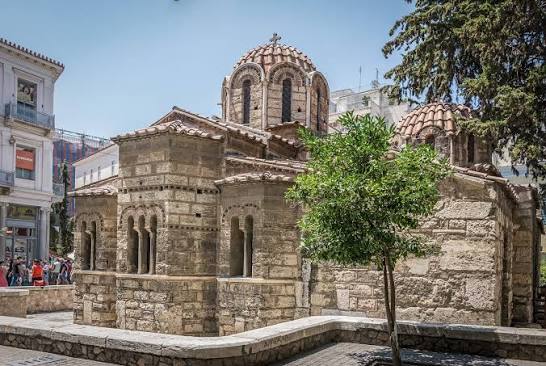
The 11th and 12th centuries are widely recognized by historians and architects as the golden age of Byzantine church construction in Athens. During this middle Byzantine period, the city’s builders created some of the most architecturally sophisticated and aesthetically refined religious buildings to survive from medieval Europe. The churches are characterized by their small proportions, elaborate decorative brickwork, and the distinctive cross-in-square architectural design that allowed for a harmonious balance of interior space beneath a high dome.
Panagia Kapnikarea, dating to approximately 1050 AD, exemplifies this architectural achievement. Built on the site of an earlier classical temple, this small church measures approximately 8 meters in each direction and features all the hallmarks of middle Byzantine design. The church has survived fires, wars, and Ottoman occupation, retaining enough of its original structure and decoration to give visitors a vivid sense of what middle Byzantine religious architecture looked like at its finest.
Agios Eleftherios, sometimes paired with Panagia Gorgoepikoos on Mitropoleos Square, represents the same period and the same architectural sensibilities, yet with its own distinctive features and history. The church is dedicated to Saint Eleftherios, the protector of mothers and infants, a continuation of an earlier association with the goddess Eileithyia that connects pagan and Christian sacred traditions in a single building.
What most distinguishes these churches as distinctly Athenian are their distinctive red-tiled, eight-sided domes, known as Athenian Domes. This dome form became the signature architectural element of medieval Athens, appearing on countless churches throughout the city and becoming one of the most recognizable features of Byzantine Greek architecture. When you see one of these distinctive domes rising above a Byzantine church, you know you are looking at an Athenian building specifically, a product of the city’s particular architectural tradition.
Both churches are extraordinary in their preservation and their continuing function as active places of worship. Unlike many medieval churches that have become museums or archaeological sites, these churches remain fundamentally as they were designed centuries ago, with living communities of believers still gathering for services, prayers, and religious observance. This continuity of function gives them a spiritual and historical authenticity that cannot be replicated in any reconstruction or museum display.