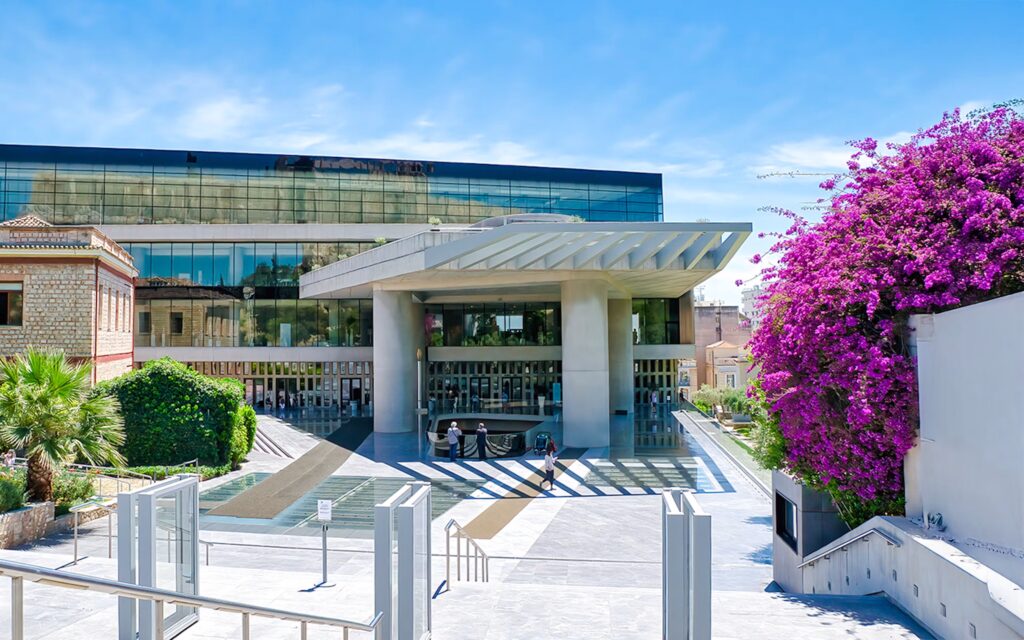
The Acropolis Museum was created to solve a problem that had troubled Athens for more than a century. The original museum on the Acropolis, completed in 1874, had long since run out of space to house the growing number of artifacts recovered from the sacred rock and its slopes. The new museum, designed by Bernard Tschumi in collaboration with Greek architect Michael Photiadis, was conceived not simply as a storage and display space but as a building in dialogue with the monument it serves.
The building itself is a work of art. It sits on more than one hundred concrete pillars above an active archaeological excavation, and glass floors throughout the museum allow visitors to look down into the remains of a fifth-century Athenian neighborhood, complete with houses, workshops, streets, and drainage systems. Walking across these glass floors, suspended above the ancient city, is one of the most memorable experiences the museum offers.
The ground-floor gallery, known as the Gallery of the Slopes of the Acropolis, presents finds from the sanctuaries and settlements on the hill’s slopes, including votive offerings and everyday objects that illuminate ancient Athenian life. The floor slopes gently upward, echoing the ascent to the Acropolis itself.
The Archaic Gallery on the first floor houses one of the finest collections of archaic sculpture in the world, including the famous korai, the elegantly draped female statues, and kouroi, the standing male figures, along with the celebrated Moschophoros or Calf-Bearer from around 570 BC. These works, carved before the classical age reached its peak, retain the enigmatic archaic smile that gives them their distinctive character.
The crown of the museum is the top-floor Parthenon Gallery, a glass-walled hall built to the exact dimensions and orientation of the Parthenon itself. Here the surviving sculptures of the Parthenon frieze, metopes, and pediments are displayed in their original arrangement, with the Acropolis visible through the glass walls beyond. The gallery was deliberately designed to hold the entire frieze, including space for the sections currently held in the British Museum in London, a quiet architectural argument for the eventual reunification of the Parthenon Marbles.
Five of the six original Caryatids, the sculpted female figures that once supported the porch of the Erechtheion, stand in their own dedicated gallery, having been moved indoors to protect them from pollution and weathering. The sixth remains in London. Seeing these extraordinary figures up close, at eye level, is one of the great privileges the museum offers.