Book Athens Transfers to The Ancient Agora and Temple of Hephaestus

Book Athens Transfers to The Ancient Agora and Temple of Hephaestus

Traveling from Athens International Airport to the Ancient Agora and Temple of Hephaestus brings you to the place where classical Athens truly lived. While the Acropolis was the sacred and symbolic heart of the city, the Agora was where daily life actually happened, where citizens debated, traded, voted, and argued, and where Socrates himself walked and questioned everyone he met, making a well-organized athens transfer the most fitting way to begin a visit of this depth.

Book Athens Transfers to The Ancient Agora and Temple of Hephaestus

Distance and Travel Time from Athens Airport to The Ancient Agora and Temple of Hephaestus

Athens International Airport Eleftherios Venizelos is approximately 35 kilometers from the Ancient Agora, and the journey into the historic center of Athens typically takes between 35 and 55 minutes depending on traffic and the time of day.

The Agora sits in the heart of the city between the Monastiraki and Thissio metro stations, in one of the most densely visited and navigated corners of central Athens. The streets around Monastiraki Square and Adrianou Street carry a constant flow of visitors and locals throughout the day, and finding the right entrance to the site for the first time, particularly after a long flight with luggage, requires more local knowledge than it might appear.

Book Athens Transfers takes all of that off your hands before you even land. A professional driver handles the route and timing from the airport, delivering you to the area with enough time and energy to spend on the site itself rather than on the logistics of getting there.

The Heart of Ancient Athens

The Ancient Agora of Athens is one of the most layered and historically rich archaeological sites in the world, covering more than twelve centuries of continuous use from the sixth century BC through to the Byzantine period. Understanding what the space meant to the people who used it transforms a visit from a walk among ruins into something altogether more powerful.

In its classical heyday the Agora was the absolute center of Athenian public life. It was here that the democratic assembly first gathered, that citizens cast their votes using bronze ballots, that the courts of justice held their trials, that merchants sold their goods under the colonnades, and that philosophers argued in the open air about the nature of justice, beauty, and the good life. Socrates spent much of his time in the Agora, engaging strangers and citizens alike in the kind of probing, uncomfortable conversation that would eventually lead to his trial and execution. Walking the Panathenaic Way, the ancient processional road that cuts diagonally through the site, with that knowledge in mind changes the experience entirely.

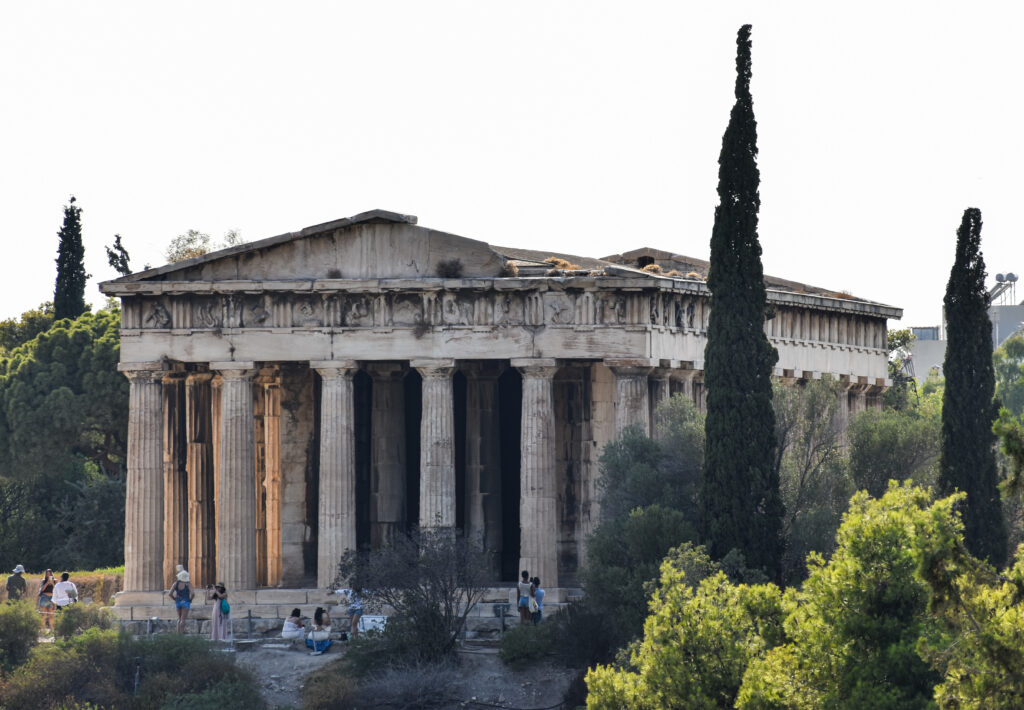
The Temple of Hephaestus stands on the Kolonos Agoraios, a low hill at the western edge of the Agora, and it is the single most impressive structural survival of the entire site. Built from Pentelic marble starting around 450 BC and dedicated jointly to Hephaestus, the god of metalworking and fire, and to Athena, the patron of craft and industry, it is the best-preserved ancient Greek temple anywhere in Greece. Where the Parthenon has lost its roof, most of its sculpture, and all of its color, the Temple of Hephaestus retains its full structural form, with both colonnades intact, the roof in place, and the interior walls largely surviving. It gives visitors a clearer sense than any other monument in Athens of what a complete classical Greek temple actually looked like from the outside in its original condition.

The temple’s survival owes much to an unusual history. It was converted into a Greek Orthodox church dedicated to Saint George around the seventh century AD, a function that protected it from the kind of systematic spoliation that destroyed most other ancient buildings in the city. The last liturgy held inside the temple was in 1834, when it served as the official site for welcoming King Otto, the first king of the modern Greek state. Shortly afterward the building was handed over to archaeology and has been carefully maintained ever since.

The Agora itself rewards slow exploration. Beyond the Temple of Hephaestus and the reconstructed Stoa of Attalos, the site contains the circular Tholos where the Prytaneis, the executive committee of the Athenian assembly, met and ate together, the foundations of the Metroon, the state archive, the Altar of the Twelve Gods, and the remains of the great Stoa of Zeus. The entire landscape is green and surprisingly quiet given its central location, and resident tortoises are a familiar sight on the lawns in front of the temple, apparently as comfortable with the attention of visitors as the ancient Athenians must have been with the scrutiny of Socrates.

Private Transfer from Athens Airport to The Ancient Agora and Temple of Hephaestus

A private transfer with Book Athens Transfers is the most reliable and comfortable way to travel from Athens Airport to the Ancient Agora area. From the moment you walk through arrivals, your driver will be there with a name sign, ready to take your luggage and escort you directly to the vehicle without any waiting or confusion.

Real-time flight monitoring is built into every pre-booked private athens transfer with Book Athens Transfers. Whether your flight lands on time, early, or delayed, your driver has already adjusted the pickup before you even collect your bags. The process runs automatically and requires nothing from you in the arrivals hall.

The service is door-to-door from the terminal to the Monastiraki or Thissio area, with no shared stops or unnecessary detours. Fixed pricing agreed at booking means the full cost is clear before you travel, with nothing to negotiate or recalculate at the other end. For a site as historically significant as the Ancient Agora, arriving relaxed and on schedule is simply the right way to begin.

Premium Transfer for a Day in Classical Athens

A visit to the Ancient Agora and Temple of Hephaestus is not a quick tourist checkbox but a genuine immersion in the origins of Western civilization, and a premium transfer from Book Athens Transfers is a fitting way to begin a day of that quality. Premium vehicles include executive sedans or high-end cars that offer a quiet, refined, and thoroughly comfortable journey from the airport through to the heart of classical Athens.

A premium athens transfer suits historians, classicists, and culturally motivated travelers for whom the Ancient Agora is the centerpiece of the Athens visit, as well as any guest who simply prefers the composure of an executive vehicle after a long-haul flight. The professionalism of the driver and the quality of the vehicle set a calm and organized tone that carries well into a morning of serious sightseeing.

Booking a premium transfer in advance with Book Athens Transfers is also the most dependable way to lock in your vehicle, particularly during the spring and summer months when Athens is at its busiest and demand for quality transfers across the city builds steadily.

Athens Airport Minivan for Groups, Families, and School Parties

The Ancient Agora is one of the most popular educational destinations in Athens, drawing school groups, university tours, and family parties with a genuine interest in classical history. For larger groups arriving from the airport together, an Athens Airport Minivan from Book Athens Transfers is the most practical and cost-effective solution.

Minivans provide generous seating and ample luggage space, keeping the entire group in one vehicle from the arrivals terminal straight through to the Monastiraki area without the need for separate bookings or split arrivals. For organized groups where everyone needs to arrive together and on a shared schedule, a minivan from Book Athens Transfers removes the coordination difficulty entirely. When booking your athens transfer, simply provide your passenger numbers and luggage details, and the right vehicle will be confirmed and ready when you land.

The Agora Deserves a Better Arrival Than a Taxi Queue

Taxis from Athens International Airport operate on fixed fares and are available around the clock, but for a visit as carefully planned as a day in the Ancient Agora, the unpredictability of a rank taxi introduces unnecessary risk at the very start. Queue times during busy arrival periods can be significant, and there is no flight monitoring, no assigned driver, and no vehicle quality guarantee.

The Ancient Agora is a site that rewards the visitor who arrives with time, energy, and curiosity intact. Starting the day with an uncertain wait at the airport taxi rank and a stressful, unplanned journey into the historic center uses up exactly the kind of patience and focus that the site itself deserves.

The Agora Deserves a Better Arrival Than a Taxi Queue

Booking your athens transfer with Book Athens Transfers puts a professional, experienced driver in charge of the full journey from the airport to the Agora area. With solid knowledge of the Monastiraki neighborhood, the streets around Thissio, and the most efficient routes into the historic center, your driver will have you there smoothly and on time, whatever hour your flight arrives.

The site is open daily and admission is included in the combined Acropolis ticket, which also covers the Temple of Hephaestus, the Agora Museum inside the Stoa of Attalos, and several other sites across the historic center. Plan to spend at least two hours on the site, more if you intend to explore the museum carefully, and wear comfortable shoes as much of the ground is uneven and unpaved.

Whether you choose a standard private vehicle, a premium transfer, or an Athens Airport Minivan, organizing your ride with Book Athens Transfers means you arrive at the Ancient Agora with everything already sorted and nothing standing between you and one of the most remarkable places in the ancient world.

Share this post