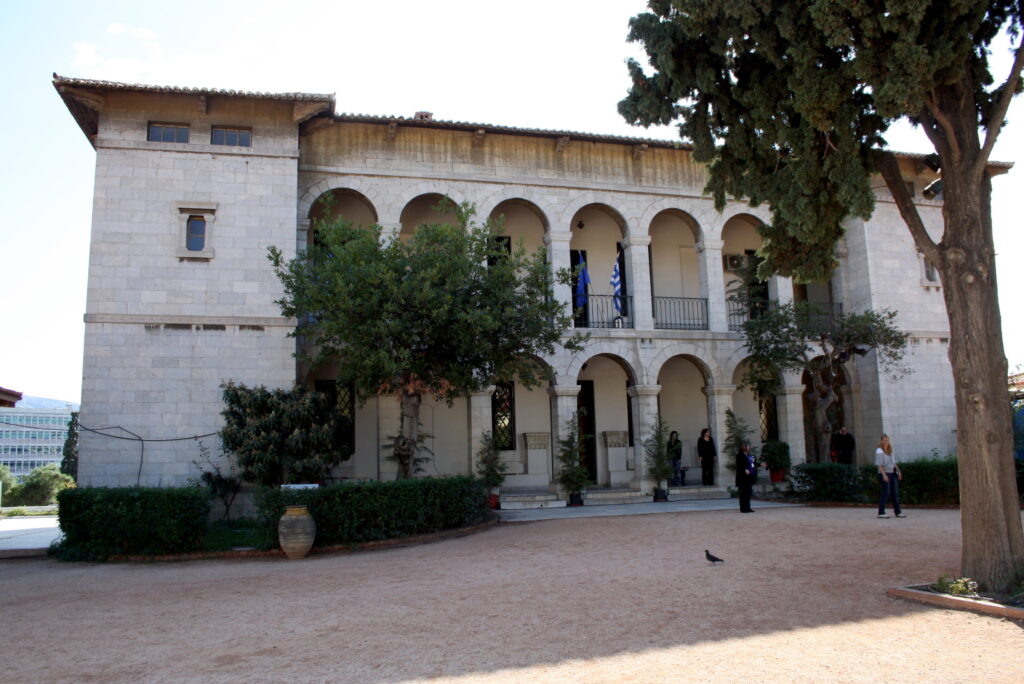
The Byzantine and Christian Museum is one of the most important museums in the world dedicated to Byzantine art, and its collection offers an unparalleled window into the artistic and spiritual world of the Eastern Roman Empire and the Orthodox Christian tradition that grew from it. The museum was founded in 1914, at a time when scholarly appreciation of Byzantine art was still developing, and it has grown into a comprehensive institution that traces the entire arc of Christian art in the Greek world.
The museum is housed in the Villa Ilissia, an elegant residence built in the mid-nineteenth century for the Duchess of Plaisance, a wealthy French aristocrat who became a prominent figure in the social life of newly independent Athens. The villa and its surrounding grounds provide a graceful and atmospheric setting, and later additions have expanded the exhibition space into a modern underground gallery complex that displays the collection in carefully controlled conditions.
The permanent collection is organized to guide visitors through the historical development of Byzantine and post-Byzantine art. The earliest galleries address the transition from the ancient pagan world to early Christianity, presenting how classical artistic forms were adapted to serve the new religion, including sculptures, architectural fragments, and objects that show pagan motifs gradually giving way to Christian symbolism.
The heart of the collection is its extraordinary holdings of Byzantine art proper, spanning the centuries when Constantinople was the center of the Christian world. Here visitors find some of the finest icons anywhere in existence, painted panels depicting Christ, the Virgin, and the saints in the distinctive Byzantine style that emphasized spiritual presence over naturalistic representation. The collection includes wall paintings and frescoes, some transferred from churches, as well as mosaics, illuminated manuscripts, liturgical vessels, ecclesiastical vestments, and intricate metalwork.
Among the treasures are double-sided icons carried in religious processions, marble sculptures and reliefs, and objects of gold, silver, and enamel that reveal the technical brilliance of Byzantine craftsmen. The collection illustrates not only the religious function of these works but also the theological ideas and artistic conventions that governed their creation over the course of more than a thousand years.
The post-Byzantine galleries carry the story forward through the centuries of Ottoman rule, when Greek Orthodox art continued to flourish under difficult circumstances, preserving and adapting the Byzantine tradition. This section includes icons from the important Cretan school of painting, where the young Domenikos Theotokopoulos, later famous as El Greco, received his early training before departing for Italy and Spain.
For any visitor seeking to understand the transition from the classical ancient world to the medieval Christian one, and the extraordinary artistic tradition that sustained Greek identity through centuries of foreign rule, no collection in Athens tells that story more completely or more beautifully.