The Cycladic civilization flourished in the islands of the central Aegean, the Cyclades, during the Bronze Age, roughly between 3200 and 2000 BC. This early Aegean culture produced one of the most distinctive and instantly recognizable artistic traditions of the ancient world: marble figurines carved with an extraordinary economy of form, reducing the human figure to its essential geometry with a purity and simplicity that looks astonishingly modern to contemporary eyes.
The most characteristic of these are the folded-arm figures, typically depicting a standing female form with arms crossed over the abdomen, the head tilted slightly back, the features reduced to little more than a prominent nose on an otherwise blank oval face. Carved from the pure white marble of the Cycladic islands, particularly Paros and Naxos, these figures range from a few centimeters to nearly life size. Their abstract elegance had a direct and acknowledged influence on the pioneers of modern sculpture and painting, who saw in them a confirmation of their own search for essential form.
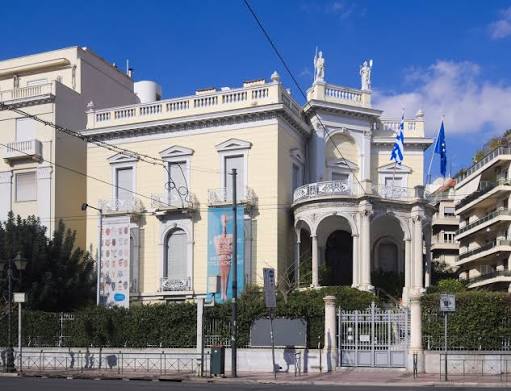
The Museum of Cycladic Art was created to house the private collection assembled by Nikolaos and Dolly Goulandris, members of a prominent Greek shipping family who spent decades acquiring Cycladic and ancient Greek art. The museum opened in 1986 in a purpose-designed modern building and has since expanded to incorporate an adjacent neoclassical mansion used for temporary exhibitions.
The Cycladic collection on the first floor is the heart of the museum and one of the finest and most comprehensive holdings of Cycladic art in existence. The figurines are displayed with careful attention to lighting and presentation, allowing their sculptural qualities to be appreciated fully. Alongside the famous folded-arm figures are vessels, tools, weapons, and other objects that place the figurines in the context of the daily and ritual life of the Cycladic islanders.
The upper floors present a broad collection of ancient Greek art spanning from the Bronze Age through the classical and Hellenistic periods to Roman times, including pottery, bronzes, glass, and jewelry, as well as a dedicated collection of Cypriot antiquities. A particularly engaging permanent exhibition uses the museum’s objects to illustrate scenes from daily life in ancient Greece, from birth and childhood through marriage, work, warfare, and death.
The museum has developed a reputation for the quality and ambition of its temporary exhibitions, which frequently bring major international works to Athens and place ancient art in dialogue with modern and contemporary pieces, reflecting the enduring conversation between the Cycladic aesthetic and the art of our own time.