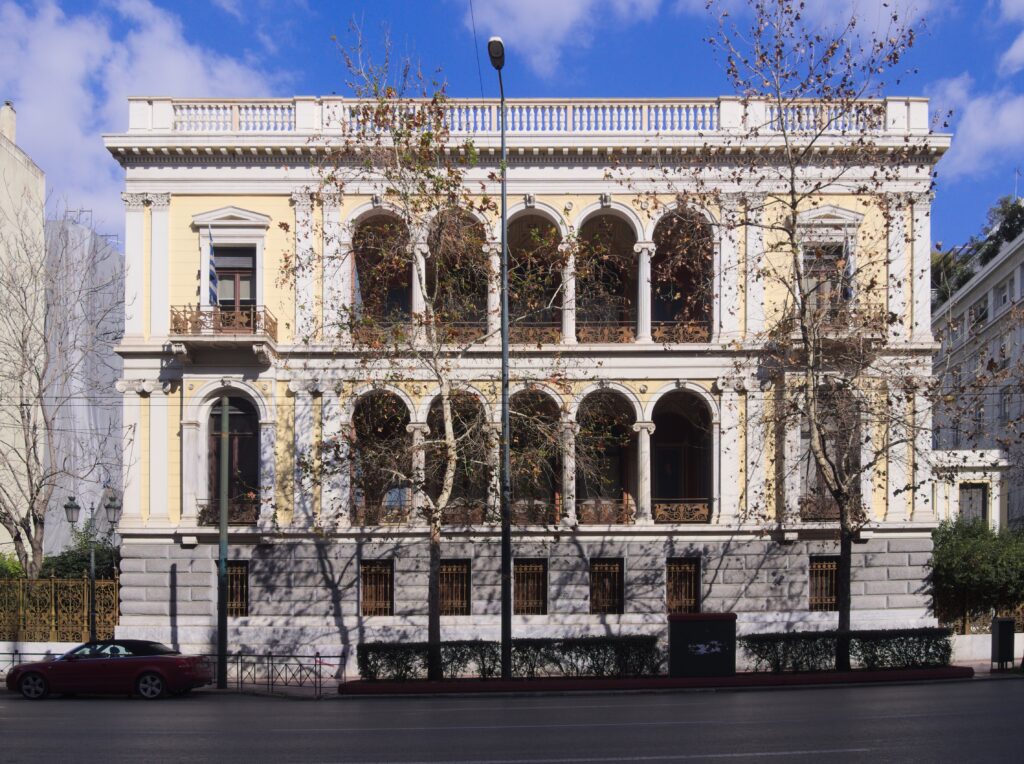
The Numismatic Museum is unusual among the museums of Athens in that the building itself is very nearly as much of an attraction as the collection it houses. The Iliou Melathron, meaning the Palace of Ilion, or Troy, was built between 1878 and 1880 as the private residence of Heinrich Schliemann, the German businessman turned archaeologist whose excavations at Troy and Mycenae made him one of the most famous and controversial figures in the history of archaeology.
Schliemann commissioned the celebrated architect Ernst Ziller, the most sought-after designer in Athens at the time, to create a residence worthy of his fame and fortune. Schliemann, who had grown up in poverty and hated the cramped rooms of his childhood, demanded a house filled with air and light, with grand, high-ceilinged rooms flooded with natural illumination. At the time of its completion, the Iliou Melathron was considered the most magnificent private residence in all of Athens.
The building is a Renaissance Revival palace with a strong neoclassical character, and its interior decoration reflects Schliemann’s consuming passion for antiquity. The mosaic floors, created by Italian artisans, depict finds from his own excavations, including Mycenaean cups and other objects he unearthed. The wall and ceiling frescoes, painted by the Slovenian artist Jurij Subic, portray classical themes, scenes inspired by Homer and Pausanias, and playful depictions of cherubs conducting their own miniature excavations. Throughout the building, motifs drawn from Mycenaean and Trojan finds appear as decorative elements, turning the entire mansion into a monument to Schliemann’s archaeological achievements.
After Schliemann’s death, the building passed through various uses, serving for decades as the seat of the Council of State and later the Supreme Court, before being restored and handed to the Numismatic Museum, which opened its displays here in the late 1990s.
The collection itself is one of the finest and largest in the world, comprising around 500,000 coins along with medals, seals, weights, and other monetary objects spanning from antiquity to the modern era. The exhibits are arranged chronologically, allowing visitors to follow the entire history of coinage from its origins in the ancient Greek world through the Roman and Byzantine periods to modern times.
The ancient Greek collection is particularly rich, tracing the development of coinage from the sixth century BC, when the Greek city-states first began to strike coins, through the classical and Hellenistic periods. The coins are not merely objects of monetary history but miniature works of art, bearing exquisitely detailed images of gods, heroes, animals, and civic symbols that reveal the artistic achievements and political identities of the cities that produced them. An exceptional collection of Byzantine coins occupies the upper floors, and displays of Schliemann’s own personal coin collection connect the treasures directly to the man who built this extraordinary house.