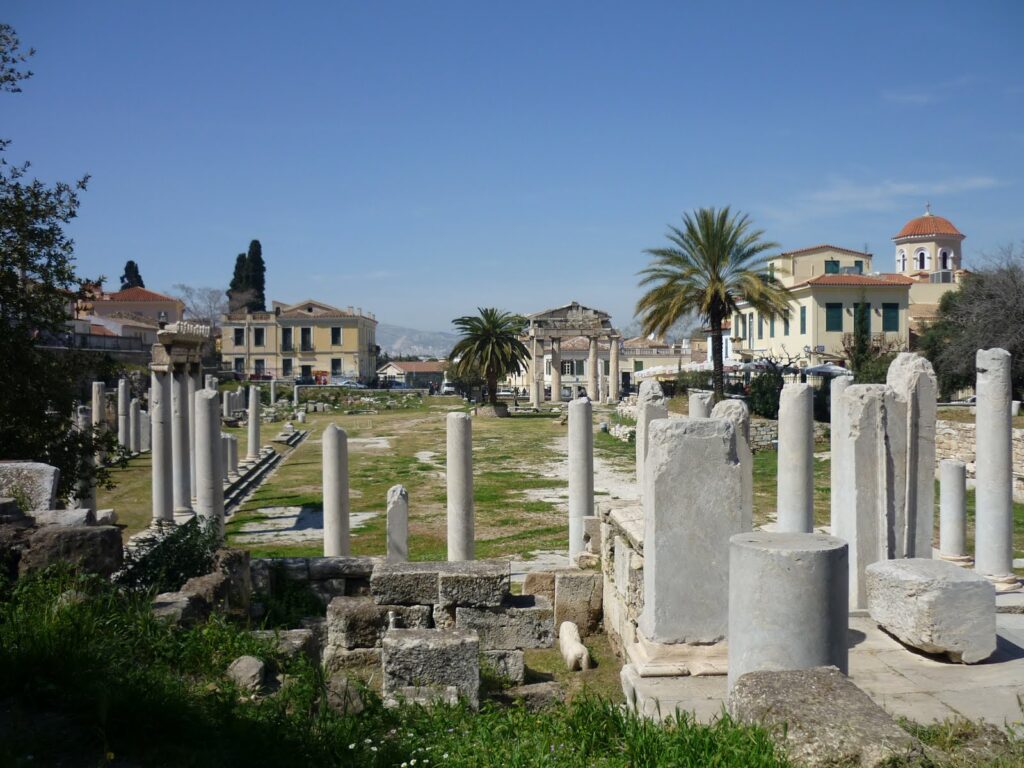
The Roman Agora of Athens occupies a fascinating position in the city’s history. By the time Julius Caesar and Augustus provided the funds to build it in the late first century BC, the Ancient Greek Agora that lay just to its west was already several centuries old and beginning to feel the pressure of a growing city.
The Roman Agora was conceived as a dedicated commercial marketplace to supplement the older civic space, a rectangular colonnaded enclosure approximately 112 meters long and 98 meters wide, surrounded by covered colonnades that housed shops and storage spaces on all sides.
The main entrance from the west, known as the Gate of Athena Archegetis, survives in impressive condition. Four Doric columns support a heavy entablature inscribed with a dedication to Athena and an acknowledgment of the financial contributions of Julius Caesar and Augustus, a vivid reminder of how deeply Rome had embedded itself in the public life of Athens by this period.
A second gate on the eastern side of the enclosure and sections of the surrounding walls also survive, along with the remains of a public latrine, a market inspector’s office, and an Ottoman-era mosque built within the ruins during the period of Turkish occupation. The layering of Greek, Roman, Byzantine, and Ottoman remains within this single compact site is one of its most historically striking features, a kind of compressed timeline of everything Athens has survived and absorbed over two and a half thousand years.
The undisputed centerpiece of the site is the Tower of the Winds, which stands just outside the eastern boundary of the Roman Agora enclosure and is one of the best-preserved ancient buildings anywhere in the city. Built around 50 BC by the astronomer Andronicus of Cyrrhus, it is an octagonal tower of Pentelic marble standing approximately 12 meters high, and it was designed to function as a complete meteorological and timekeeping instrument.
Each of its eight faces points toward one of the cardinal and intercardinal directions, and each is decorated with a carved relief figure representing the wind that blows from that direction. Boreas, the cold north wind, appears as a heavily cloaked old man on the north face.
Zephyros, the gentle west wind associated with spring and warmth, appears as a young man scattering flowers on the west face. The other six winds, Kaikias, Apeliotes, Euros, Notos, Lips, and Skiron, each occupy their respective faces in similarly distinctive forms.
Below the carved wind figures, each face of the tower originally carried a bronze pointer set into the wall that functioned as a sundial when the sun cast its shadow across the carved hour lines on the marble surface.
Inside the tower a water clock driven by a stream from the Acropolis provided timekeeping on cloudy days and at night, and a bronze weather vane mounted on the conical roof completed the instrument by indicating which of the eight winds was blowing at any given moment. The combination of sundial, water clock, wind vane, and directional marker in a single building was an achievement of remarkable ingenuity for its time and remains one of the most impressive practical structures to survive from the ancient world.
The tower survived the centuries in unusually good condition largely because it was converted into a Christian chapel during the Byzantine period, a function that protected it from demolition and spoliation. During the Ottoman period it served briefly as a place of worship for dervishes, and its interior was decorated accordingly, traces of which are still visible on the walls.
Restoration work completed in 2016 has left the exterior in excellent condition, and the building can be examined closely from all sides from within the site.