
Located within the Ancient Agora complex, the Stoa of Attalos is a fully reconstructed two-story colonnaded building that originally served as a covered marketplace and social gathering space in the second century BC. It was rebuilt between 1953 and 1956 by the American School of Classical Studies and today houses the Agora Museum on its ground floor. The museum contains an outstanding collection of artifacts recovered from the site, including pottery, bronze objects, coins, and sculpture spanning more than a thousand years of Athenian history. The reconstruction itself is a remarkable piece of work, giving visitors a vivid sense of what the ancient public spaces of Athens looked and felt like at the height of the city’s power.
Athens Airport to Ancient Athens A Complete Guide to the City's Archaeological Sites
Athens Airport to Ancient Athens A Complete Guide to the City's Archaeological Sites
Athens is one of the oldest continuously inhabited cities in the world, and nowhere is that more visible than in its ancient monuments. From the moment you arrange your athens transfer from the airport and step into the city, the evidence of a civilization that shaped the entire Western world surrounds you on every corner. This guide covers twelve of the most important ancient monuments and archaeological sites in Athens, each one a chapter in a story that stretches back more than two and a half thousand years.
There is no more iconic image in all of Greece than the Acropolis, the sacred rock rising above the city with the Parthenon at its crown. This ancient citadel sits at the heart of Athens and contains four of the most celebrated monuments in human history. The Parthenon, dedicated to the goddess Athena, is the defining achievement of classical Greek architecture, built entirely from Pentelic marble in the fifth century BC under the direction of Pericles. The Erechtheion stands to its north, famous above all for the Porch of the Caryatids, where six sculpted female figures serve as columns in place of stone. The Temple of Athena Nike occupies a small bastion at the entrance to the complex, its elegant proportions offering some of the finest views across the city and toward the Saronic Gulf. The Propylaea forms the grand monumental gateway through which visitors pass to reach the summit, a masterwork of Doric and Ionic architecture that sets the tone for everything that lies beyond.
The Acropolis is the single most visited site in Greece and is best explored in the early morning hours before the summer heat and the crowds build. A good athens transfer gets you to the base of the hill efficiently, giving you the best possible start to a visit that will stay with you for the rest of your life.
Odeon of Herodes Atticus
Built into the southern slope of the Acropolis in the second century AD by the wealthy Roman senator Herodes Atticus in memory of his wife, the Odeon is one of the great surviving performance spaces of antiquity. Its stone seating, reconstructed with Pentelic marble in the 1950s, can accommodate around 5,000 spectators and has been in continuous use for performances ever since. Each summer, the Athens Epidaurus Festival fills the Odeon with concerts, opera, theatre, and dance against a backdrop that no modern venue in the world can replicate. Arriving for an evening performance here via a well-organized athens transfer, with the lit Acropolis rising directly behind the stage, is an experience that belongs in a category entirely its own.
Carved into the southeastern slope of the Acropolis hill, the Theatre of Dionysus holds the distinction of being the birthplace of Greek drama. It was here, from the sixth century BC onward, that the works of Aeschylus, Sophocles, Euripides, and Aristophanes were first performed in competition at the Great Dionysia festival. The theatre could originally hold up to 17,000 spectators and was later rebuilt in marble during the fourth century BC. While much of the structure has not survived intact, walking the ancient orchestra floor and sitting on the remaining stone thrones of honor is a genuinely moving experience for anyone with an interest in literature, history, or the performing arts.
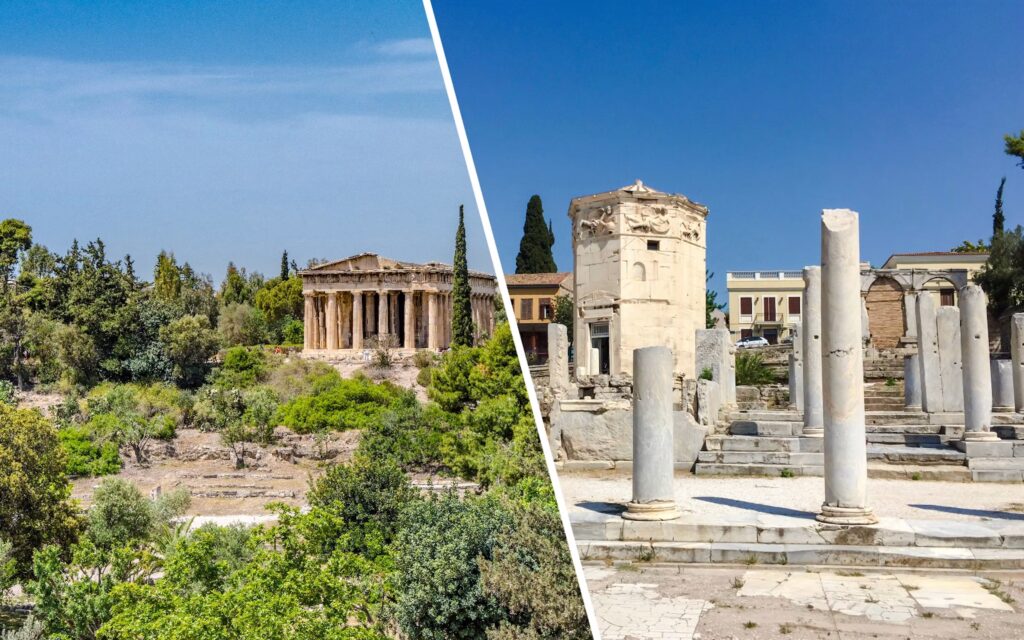
The Ancient Agora was the commercial, political, and philosophical heart of classical Athens. It was here that Socrates walked and argued, that citizens gathered to discuss the affairs of the city, and that the foundations of Western democratic thought were laid in public debate. The site is extensive and richly layered, with the remains of public buildings, stoas, temples, and civic spaces spread across a large and surprisingly green archaeological park. At its western edge stands the Temple of Hephaestus, the best-preserved Doric temple in all of Greece. Built in the fifth century BC, it remains almost entirely intact and gives a clearer sense than any other surviving monument of what a complete classical Greek temple actually looked like in its original form.
A short walk northeast of the Ancient Agora, the Roman Agora was built during the first century BC as a commercial marketplace funded by Julius Caesar and Augustus. It served as the main trading center of Athens during the Roman period and remains a rewarding site to explore today. The standout monument within the complex is the Tower of the Winds, an extraordinary octagonal marble structure from the first century BC that functioned simultaneously as a sundial, a water clock, a weather vane, and a compass. Its eight sides are each carved with a relief figure representing one of the directional winds, and it remains one of the best-preserved ancient monuments anywhere in Athens. For a city with as much to see as Athens, the Roman Agora and the Tower of the Winds reward the visitor who arrives with enough time and energy to explore them properly.
The Emperor Hadrian, who held Athens in particular affection, left two of the most recognizable monuments in the city to mark his connection to it. Hadrian’s Library, built around 132 AD, was a vast complex housing book collections, lecture rooms, gardens, and a central pool, serving as a cultural center for the Roman city of Athens. Much of the original structure has survived, and the site offers a fascinating glimpse into how the Romans imagined and built upon the existing Greek city. Nearby, Hadrian’s Arch marks the boundary between ancient Athens and the new Roman city that Hadrian extended beyond it. Standing at the end of Amalias Avenue at the edge of Plaka, the arch remains in remarkably good condition and is one of the most photographed structures in modern Athens.
The Temple of Olympian Zeus, known also as the Olympieion, was once one of the largest temples in the entire ancient world. Its construction began in the sixth century BC but was not completed until the reign of Hadrian more than 600 years later, making it one of history’s longest building projects. At its completion it had 104 towering Corinthian columns, of which 15 still stand today. The remaining columns rise to a height of 17 meters and are breathtaking in their scale, giving a powerful impression of just how enormous and ambitious the finished temple must have been. The site sits just southeast of the Acropolis and is most dramatically viewed at sunset, when the columns glow warm against the sky.
Kerameikos is the ancient cemetery of Athens, used continuously from the twelfth century BC through to Roman times, and it is one of the most underrated archaeological sites in the city. Located northwest of the Acropolis near the modern neighborhood of the same name, it offers a quiet, green, and surprisingly moving experience compared to the busy tourist sites that surround the Acropolis hill. Among its most significant features are the remains of the Dipylon Gate, the Sacred Gate, and substantial sections of the ancient Themistoclean Wall, as well as a remarkable collection of funerary monuments and grave markers. An on-site museum houses statues, vases, figurines, and reliefs excavated from the site, many of them objects of exceptional beauty. For travelers who want to see a different and quieter side of ancient Athens, Kerameikos is a genuinely rewarding choice.
Perched on a rocky hill southwest of the Acropolis, the Pnyx is one of the most historically significant and least visited ancient sites in Athens. It was here that the Athenian democratic assembly gathered to debate and vote on the affairs of the city state, making it one of the earliest and most important sites of democratic government in human history. At its height, the Pnyx could accommodate an assembly of up to 6,000 citizens. Today it is a largely open-air site with modest physical remains but an atmosphere of genuine historical weight, particularly when viewed from its upper slopes with the Acropolis rising against the sky to the east. It forms part of a broader hilltop landscape that also includes the Philopappos Monument and offers some of the finest views in all of Athens.
The Panathenaic Stadium, known in Greek as the Kallimarmaro, meaning beautiful marble, is the only stadium in the world built entirely from white Pentelic marble. Originally constructed around 330 BC to host the Panathenaic Games, it was rebuilt in marble by Herodes Atticus in the second century AD and later fell into disuse for centuries before being fully restored for the first modern Olympic Games in 1896. It was on this track that the first modern Olympic races were run, and the stadium has retained its athletic function ever since, serving as the finish line for the Athens Classic Marathon each November. With a seating capacity of over 50,000 and a setting that combines classical grandeur with modern sporting legacy, it is one of the most photogenic and emotionally resonant sites in the entire city.
The Philopappos Monument stands on the Hill of the Muses, also known as Filopappou Hill, just southwest of the Acropolis. Built between 114 and 116 AD to honor Gaius Julius Philopappos, a Roman consul of Syrian origin who became a beloved benefactor of Athens, the monument is a striking piece of Roman funerary architecture that fits surprisingly naturally into its Greek hillside setting. The walk to the monument is one of the most pleasant in Athens, passing through a pine-shaded park with paths that wind gently upward from the Dionysiou Areopagitou pedestrian street. At the summit, the views of the Acropolis and the Parthenon are arguably among the best in the city, unobstructed and deeply atmospheric, particularly in the early morning or late afternoon light.
Visiting Ancient Athens with Book Athens Transfers
Athens’ ancient monuments are spread across a walkable area of the historic center, and most can be reached on foot from one another once you are in the city. The challenge for many visitors is getting from Athens International Airport to the right part of the city efficiently, with luggage, on time, and without the stress of navigating public transport in an unfamiliar place.
A pre-booked private athens transfer takes care of all of that from the moment you land. Whether you are heading directly to a hotel near the ancient sites, arriving for an evening performance at the Odeon, or simply want to begin exploring as quickly as possible after your flight, Book Athens Transfers provides professional, punctual, and door-to-door service from the airport to wherever you need to be. Premium transfers are available for guests who want a more refined experience, and Athens Airport Minivans are ideal for groups and families visiting the sites together.